* All product/brand names, logos, and trademarks are property of their respective owners.
For decades, motorsports in Pakistan were largely seen as hobby racing — exciting weekend drag events, off-road rallies, and passionate car meets. While the country has always had a strong automotive culture, professional circuit racing and international representation felt out of reach. The idea of a Pakistani driver competing on the global motorsports stage — let alone climbing the Formula 1 ladder — seemed distant. But that narrative is changing.
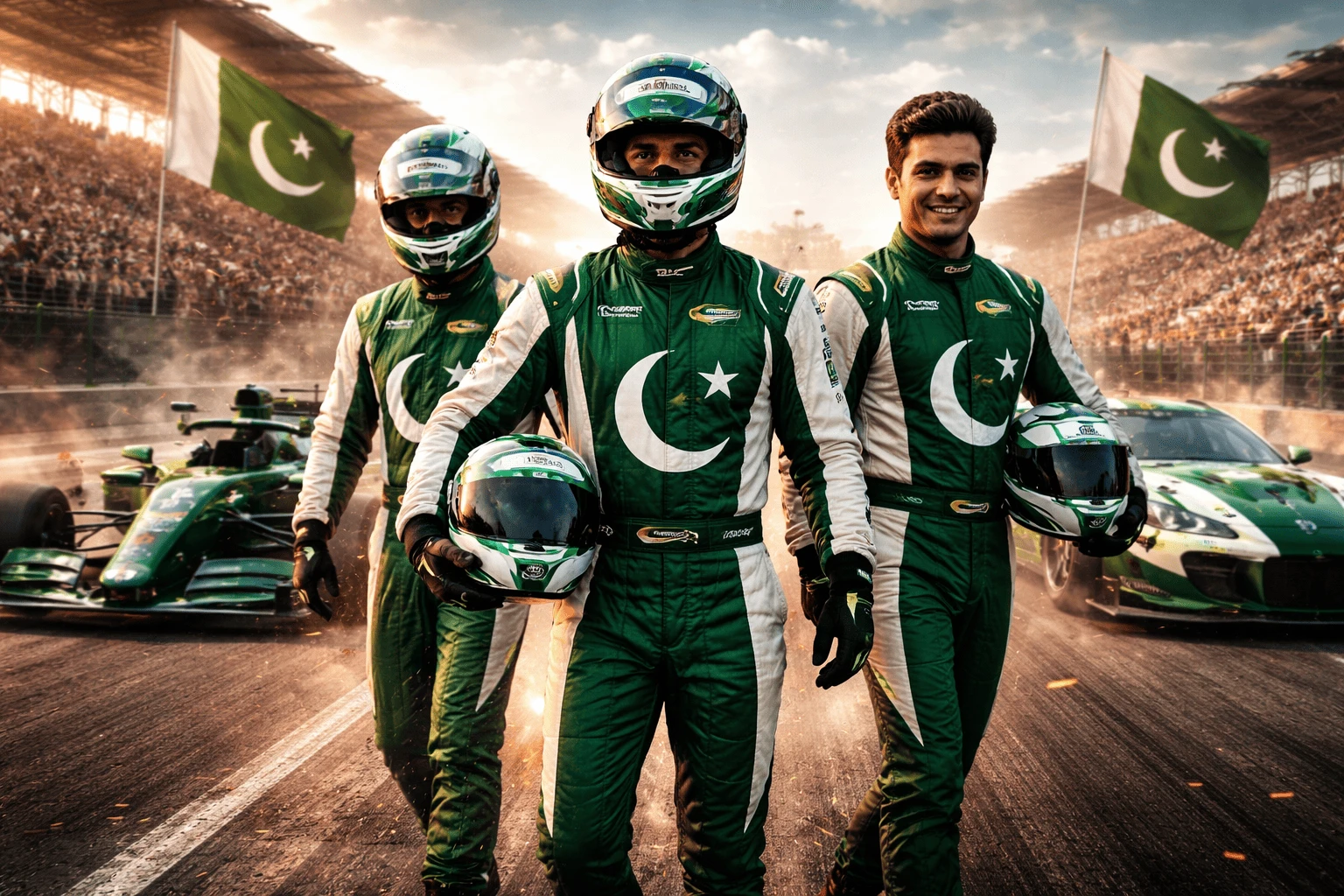
A new generation of Pakistani racing drivers is breaking barriers and entering FIA-sanctioned competitions around the world. These drivers are no longer limited to local circuits. They are racing in British Formula championships, competing in American feeder series, and holding official FIA licenses that place them within the global racing structure. What makes this moment historic is not just individual success — it’s systemic progress. For the first time, FIA karting licenses are available directly within Pakistan, allowing young drivers to enter the same structured pathway followed by Formula 1 stars. Combined with institutional initiatives and international academies, Pakistan is slowly building a sustainable motorsports ecosystem.
Names like Enaam Ahmed, Saad Ali, and Uzair Miba are not just representing Pakistan — they are redefining its place in global racing. The question is no longer whether Pakistani drivers can compete internationally. The real question is: Is Pakistan finally positioning itself to produce a Formula 1 driver?
For years, Pakistan had talent but lacked access. Countries like the UK, Italy, and France dominate junior formula racing because they have long-established systems. Pakistan, by contrast, had passionate racers but limited international exposure. That is beginning to change.
A small but determined group of Pakistani motorsport drivers has entered the FIA ladder — the same progression system that leads from karting to Formula 4, Formula 3, Formula 2, and ultimately Formula 1. Their journeys have not been easy. Limited sponsorship, infrastructure gaps, and minimal media coverage made the climb tougher than for many European counterparts. Yet, despite these challenges, they’ve broken through.

If one name has placed Pakistan firmly on the global motorsport map, it is Enaam Ahmed. Enaam made headlines by becoming a British Formula 3 Champion, breaking Ayrton Senna’s long-standing record for the most wins in a single season. That achievement alone sent shockwaves through the junior racing world. A Pakistani driver wasn’t just participating — he was dominating. He is currently the only Pakistani driver holding an FIA Gold License, a professional classification that places him among elite competitors eligible for high-level international racing. This is not symbolic recognition — it is official validation from motorsport’s governing body.
Enaam’s move to the IndyNXT series in the United States further strengthened his global presence. Securing a top-four finish at the Alabama Grand Prix, he proved his ability to adapt across continents and racing environments. Beyond statistics, Enaam changed perception. He showed sponsors, teams, and fans that Pakistani racing drivers belong on the international stage.
While Enaam opened doors, others are walking through them. Saad Ali, widely recognized as Pakistan’s first certified Formula 3 racer, has represented the country in international open-wheel circuits for years. His presence in FIA-regulated championships helped legitimize Pakistan’s ambitions in professional formula racing.
Then there is Uzair Miba, part of a growing group of Pakistani drivers now holding official FIA licenses. Licensing might sound technical, but it is the foundation of professional motorsports. Without it, drivers cannot compete in the structured global ladder. The difference today is scale. Previously, Pakistani participation felt isolated. Now, multiple drivers are entering the system. That signals the beginning of a pipeline rather than a one-off success story.
Every Formula 1 champion starts in karting. The journey typically follows this progression: Karting → Formula 4 → Formula 3 → Formula 2 → Formula 1. For years, Pakistani drivers had to go abroad to even begin that journey. Now, FIA Karting licenses can be obtained directly within Pakistan — a historic milestone. This integration means young drivers can start their careers at home while remaining aligned with international standards. Their performance records are recognized globally. Transitioning to European or Middle Eastern championships becomes smoother.
Compared to India and the UAE — countries that invested early in structured karting programs — Pakistan is entering later. However, the entry itself is progress. Once a nation becomes part of the official FIA system, sponsorship interest grows, legitimacy increases, and long-term development becomes possible. The pathway now exists. The challenge is accelerating along it.
Access has always been the missing link. Talent without structure rarely leads to sustained international success. The FIA pathway changes that. For the first time, Pakistan is formally integrated into the global motorsport ecosystem. Drivers can compete under internationally recognized regulations without having to relocate abroad immediately.

This development may seem administrative, but it is transformative. Young drivers can now obtain FIA-recognized karting licenses locally. This removes a major barrier to entry. Families no longer need to relocate to Europe at the earliest stage. Talent identification can begin earlier and more affordably.
Countries like the UAE built their racing ecosystems around strong karting foundations. That is why they consistently produce competitive drivers in regional and international championships. Pakistan is beginning to follow a similar model — though still in its early stages. With rising youth interest and digital exposure, the timing could not be better.
The road to Formula 1 requires more than speed. It demands funding, discipline, engineering support, and international competition. The Formula 4 and Formula 3 seasons can cost hundreds of thousands of dollars. For Pakistani drivers, securing sponsorship remains one of the biggest challenges. Corporate investment in motorsports is still developing compared to cricket or football.
However, visibility is improving. Success stories like Enaam Ahmed’s championship season provide proof of concept. When investors see results, confidence grows. If multiple Pakistani drivers progress simultaneously through Formula 4 and Formula 3, it increases the probability that one will eventually reach Formula 2 — the final step before Formula 1. Consistency is the goal.
Even with local licensing, international competition remains essential. Drivers must race on European circuits, work with experienced engineers, and build relationships with global teams. This is where regional hubs like Dubai become strategic. Access to high-quality circuits and competitive championships shortens the development curve. Pakistan’s future in motorsports depends on balancing local development with international exposure.
Drivers are only one piece of the puzzle. Behind every successful racing nation is an ecosystem of engineers, sponsors, event organizers, and educational institutions. Pakistan is now starting to build that ecosystem.
Enaam Ahmed has launched a driver development academy in Dubai aimed at training Muslim and South Asian drivers. This initiative bridges Pakistan, the Middle East, and Europe — providing mentorship, structured coaching, and access to competitive championships. When experienced drivers invest back into the system, growth accelerates. Knowledge transfer becomes faster, and young racers avoid common developmental mistakes. This is how sustainable motorsport industries are built.
Motorsports is as much about engineering as driving. Formula Pakistan, launched by NUST, allows students aged 14–19 to design and race miniature Formula-style cars. This STEM initiative introduces participants to aerodynamics, mechanical systems, and team coordination. Countries dominant in Formula 1 produce not only elite drivers but also world-class engineers. By nurturing technical talent early, Pakistan is laying the foundation for long-term competitiveness.
Pakistan’s domestic motorsport scene remains vibrant. The Festival of Speed (Islamabad) attracts professional cars for autocross and drag racing, helping build fan culture and sponsor interest. Meanwhile, the Cholistan Desert Jeep Rally, now in its 21st year, stands as a cornerstone of off-road racing in the region. Events like these sustain grassroots passion and maintain public engagement with motorsports. Culture fuels ambition — and ambition drives progress.

A decade ago, the idea seemed unrealistic. Today, it feels achievable. Pakistan now has internationally recognized drivers, FIA licensing integration, engineering initiatives, and growing domestic events. Challenges remain — especially in sponsorship and infrastructure — but the foundation exists. If corporate backing strengthens and multiple drivers continue progressing through the FIA ladder, the next 5–10 years could redefine Pakistan’s place in global motorsports. A Formula 1 driver from Pakistan is no longer just a dream. It is a long-term goal — and for the first time, a realistic one. The engines are running. The pathway is open. Now, it’s about speed, support, and sustained belief.
Related Article
Top Motorsports Events in Pakistan: Cholistan, Jhal Magsi & More

Mushraf Baig is a content writer and digital publishing specialist focused on data-driven topics, monetization strategies, and emerging technology trends. With experience creating in-depth, research-backed articles, He helps readers understand complex subjects such as analytics, advertising platforms, and digital growth strategies in clear, practical terms.
When not writing, He explores content optimization techniques, publishing workflows, and ways to improve reader experience through structured, high-quality content.
Motorsports moves fast on and off the track. One day, fans are watching a dramatic finish; the next,
3 June 2026
Motorsports in Pakistan are shifting gears. From humble desert gatherings to full-blown national spe
13 January 2026
In the high-octane world of Formula 1, change is constant — but every so often, the sport expe
18 December 2025
Be the first to share your thoughts
No comments yet. Be the first to comment!
Share your thoughts and join the discussion below.

.webp&w=3840&q=75)
.webp&w=3840&q=75)